

Why Many Marriages Struggle Today: 10 Hidden Causes

Introduction: “We Didn’t Plan to End Up Here”
Most couples don’t wake up one day and decide,
“Let’s build a strained, cold, emotionally exhausting marriage.”
It happens quietly.
You start out hopeful. In love. Full of plans.
Then life happens.
Bills pile up. Children arrive. Careers demand more.
Unspoken expectations creep in.
Conversations become transactional.
Affection gets postponed.
Resentment grows — silently.
Before long, you’re living with someone you once adored…
but now feel disconnected from.
If you’ve ever wondered,
“How did we get here?”
you’re not alone.
We will explore why so many marriages flounder now, not to cast blame, but to gain insight. The reason is that you can’t heal what you don’t understand.
And you can’t fix what you keep denying.
Read more: the-true-purpose-of-marriage
1. Unrealistic Expectations: The Marriage Myth We All Bought Into
Many marriages struggle long before the wedding day.
Why?
Because couples enter marriage carrying unspoken fantasies instead of realistic expectations.
We were sold a story that says:
- Love should always feel good
- Conflict means something is wrong
- If I’m unhappy, my spouse is the problem
- Marriage should complete me
But real marriage doesn’t work like that.
Marriage exposes you before it completes you.
It reveals your wounds, your fears, your emotional habits.
A real-life example
A couple once told me:
“We love each other, but we didn’t know marriage would require this much emotional work.”
They expected chemistry to carry them.
Chemistry fades.
Character doesn’t.
When expectations aren’t adjusted, disappointment grows — and disappointment quickly turns into blame.
Question to reflect on:
What did you expect when you got married that was never discussed?
2. Emotional Immaturity: Two Grown-Ups, Yet Still Not Mature

Enough It’s not as if age always matches maturity. There’s a lot of couples out there you wouldn’t trust to take care of your child, though they are technically legal adults (both 18 or older). That shows up as:
- Shutting down instead of talking
- Exploding instead of expressing
- Avoiding difficult conversations
- Needing to “win” arguments
In many homes, one or both partners never learned:
- How to regulate emotions
- How to express needs without attacking
- How to listen without defending
A familiar scene
One partner raises a concern.
The other hears criticism.
Voices rise.
Walls go up.
Nothing gets resolved.
Over time, couples stop trying.
Silence replaces dialogue.
Distance replaces intimacy.
Read more: why-men-bottle-up-emotions
Hard truth:
Marriage doesn’t fail because of problems.
It fails because couples lack the emotional tools to handle them.
3. Poor Communication: Talking Often, Connecting Rarely
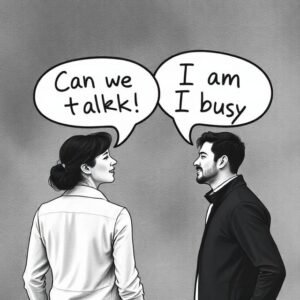
Though most couples talk everyday, they either talk about the wrong things, or at the wrong time, or in the wrong way. No one seems to hear the other well
Communication in struggling marriages often becomes:
- About logistics, not feelings
- About children, not connection
- About money, not meaning
“I told you already” replaces “Help me understand.”
“You always…” replaces “I feel…”
A simple example
A wife says, “You never help around the house.”
What she means is, “I feel alone and overwhelmed.”
A husband hears criticism, not emotion.
He withdraws.
She pushes harder.
The cycle repeats.
Poor communication isn’t about words.
It’s about misunderstood needs.
Pause and ask yourself:
When last did you listen to your spouse without preparing a response?
4. Financial Pressure: When Money Becomes the Third Partner
Money is one of the biggest silent stressors in marriage.
Not because couples don’t love each other —
but because finances touch everything:
- Power
- Control
- Security
- Identity
- Self-worth
In many homes:
- One partner earns more and feels superior
- The other feels inadequate or controlled
- Financial stress creates fear, secrecy, or blame
A common pattern
A husband feels pressure to provide.
He works longer hours.
Emotional availability drops.
The wife feels neglected.
Resentment builds.
Both feel unappreciated.
Neither feels safe enough to say it.
Important note:
Money problems rarely break marriages.
What breaks them is how couples handle fear, shame, and power around money.
5. Unresolved Childhood Wounds Brought Into Marriage
Marriage doesn’t start on a blank slate.
We bring our childhood experiences with us — whether we admit it or not.
If you grew up with:
- Absent parents
- Constant conflict
- Emotional neglect
- Harsh discipline
Those experiences shape how you love.
Examples:
- If love was conditional, you fear rejection
- If emotions were dismissed, you avoid vulnerability
- If conflict felt unsafe, you shut down or explode
Many marital conflicts are old wounds replaying in adult bodies.
Read more: healing-father-wounds-break-free-and-find-peace/
Reflection question:
What did marriage look like in the home you grew up in — and how is that influencing yours today?
6. Loss of Friendship: When Marriage Becomes a Transaction

Healthy marriages are built on friendship.
But many struggling marriages lose that foundation.
Couples stop:
- Laughing together
- Dreaming together
- Spending intentional time together
Marriage becomes about roles:
- Provider
- Caregiver
- Parent
- Problem-solver
Not companions.
A quiet danger
You can live in the same house…
sleep in the same bed…
raise the same children…
and still feel deeply lonely.
Ask yourself honestly:
If we removed responsibility, would we still choose each other?
7. Cultural Pressure and Comparison
Social media has quietly damaged many marriages.
Couples compare:
- Vacations
- Houses
- Gifts
- Romantic gestures
What they don’t see:
- The arguments
- The therapy
- The tears
- The healing work
Comparison breeds dissatisfaction.
Dissatisfaction breeds resentment.
Resentment kills gratitude.
Truth:
No marriage looks good up close all the time.
8. Lack of Support Systems and Safe Spaces
Many couples are isolated.
They don’t talk to anyone.
They don’t seek help.
They don’t ask questions.
Why?
- Fear of judgment
- Pride
- Cultural silence
- Spiritual guilt
So problems grow in the dark.
Read more: safe-spaces-for-men
Reminder:
Strong marriages aren’t problem-free.
They’re support-rich.
9. Faith Disconnection and Loss of Shared Values
When couples stop anchoring their marriage in shared values, drift begins.
Faith, values, and purpose act like a compass.
Without them:
- Decisions become reactive
- Conflicts become personal
- Forgiveness becomes difficult
Marriage becomes survival, not partnership.
10. What All Struggling Marriages Have in Common
Different stories.
Different backgrounds.
Different triggers.
But most struggling marriages share this:
- Emotional disconnection
- Unspoken pain
- Unmet needs
- Fear of vulnerability
The good news?
These are learned patterns — and learned patterns can be unlearned.
Conclusion: Understanding Is the First Step to Healing
If your marriage is struggling, it doesn’t mean you failed.
It means you’re human.
Living in a demanding world.
Trying to love with limited tools.
Awareness is not blame.
Understanding is not weakness.
Seeking help is not a defeat.
It’s wisdom.
👉 In the next blog, we’ll explore how marriages can heal and be restored, even after years of dysfunction.


I am inspired all the way.you are teaching me good.i can now see .
Welcome Josephine. Subscribe and keep connected for more